
High-voltage batteries are the core of electric vehicles. They determine crucial factors, including the driving range, stability, efficiency, and reliability of the entire system. However, even the most advanced batteries can develop faults over time, and these issues should be handled by specialists.
At EV’s Republic, every battery-related service begins with a thorough diagnostic process. Understanding the root cause requires precision, hands-on experience, and the use of the right tools. Explore how we exhaustively evaluate the condition of the high-voltage system to apply the most effective HV battery repair strategy, step by step.
Step 1: Conducting comprehensive high-voltage system diagnostics
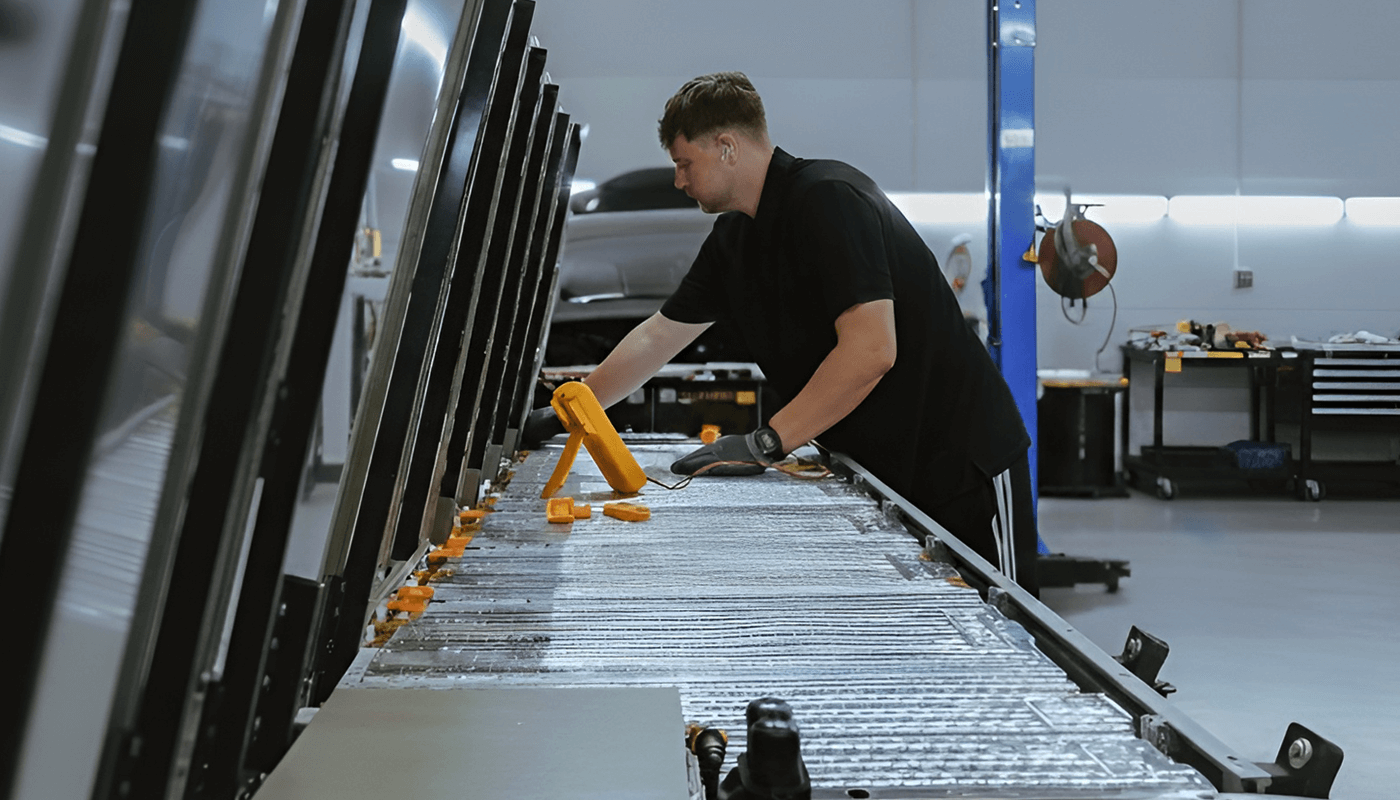
Accurate diagnostics are a sure foundation of a successful repair. To guarantee utmost accuracy, our specialists examine not only the battery but the entire HV system. During this process, we use specialized tools for different components and data types.
This is how we run the diagnostics in more detail:
Reading fault codes and analyzing BMS data
This is a vitally important part of our work as a battery management system (BMS) stores essential information, including:
- Total mileage;
- The number of charging cycles;
- The number of direct-current fast-charging events;
- Current usable capacity vs nominal;
- Module and cell balance levels;
- Thermal history and temperature deviations;
- Internal voltage and current behavior.
The above data helps us determine whether the battery is repairable and which issues require our close attention.
Diagnosing the entire vehicle, as well as the battery
At EV’s Republic, our diagnostics always cover all HV components. This is a necessary step because a fault pointing to the battery might not be caused by the battery itself.
The root cause of the problem can lie in:
- Drive motor;
- A/C compressor,
- DC-DC converter;
- Onboard charger;
- HV connectors or wiring;
- Any other high-voltage unit.
Comprehensive HV diagnostics enable us to rule out secondary causes and identify the actual problem.
Performing additional testing and professional battery disassembly
Some issues can’t be detected externally. In case we don’t identify the problem through an external evaluation, we perform a controlled, professional battery teardown.
The following problems can be revealed only internally:
- Insulation faults;
- Moisture intrusion or corrosion;
- Damaged BMB harnesses;
- Faulty individual modules;
- Welded or stuck contactors.
To diagnose these issues, our specialists carefully and safely open and reseal battery packs in accordance with industry standards.
Step 2: Identifying the exact reason for EV battery failure
Based on our experience, some common EV battery problems repeat from vehicle to vehicle.
The most frequent issues include:
- Reduced charging speed;
- Complete inability to charge;
- Cell or module imbalance;
- Low insulation resistance;
- Welded or failed contactors;
- Lost communication with BMB boards;
- Accelerated capacity degradation, and more.
Whether our customers turn to us with any of the above problems or a different issue, in-depth diagnostics allows us to accurately determine the cause of the battery fault, which is not always immediately obvious. Each case then requires a tailored solution depending on the battery’s condition and usage history.
Step 3: Choosing the best-matching repair strategy
After we perform EV battery diagnostics and identify the root cause of the failure, we offer our customers a tailored solution for their specific case. As a rule, we suggest several options and explain the pros of each.
Our flexibility is what sets EV’s Republic apart from other service centers, including Tesla. To resolve the Tesla battery issue, official service centers generally offer full battery replacement with a single predefined capacity option.
Conversely, we suggest the most technically practical and cost-effective option based on our customers’ needs and preferences. The solutions we offer are:
- Repairing the existing battery when it’s technically and financially reasonable;
- Replacing with a similar-capacity pack;
- Installing a lower-capacity battery to reduce costs;
- Installing a higher-capacity pack to extend the driving range;
- Mixed restoration options for the best price-to-result balance.
Step 4: Conducting professional EV battery repair and resealing
After we help our customers select the best-matching repair option, we then swiftly and accurately perform end-to-end repair, which includes:
- Precise battery pack disassembly;
- Replacement of failed modules;
- Repair of communication harnesses;
- Removal of corrosion and moisture;
- Insulation testing to factory specifications;
- Load testing after reassembly;
- Professional resealing using high-grade materials;
- Full system integration testing on the vehicle.
The above steps allow us to efficiently address the issue and ensure the new pack is stable, reliable, and fully recognized by the vehicle after installation.
Why turn to professionals for EV battery diagnostics and repair
Although high-voltage batteries are complex systems, most issues can be successfully resolved when diagnostics are performed expertly to select the appropriate repair strategy.
At this, high-voltage battery service should be handled only by experienced professionals who deal with these systems daily. This intricate work requires specialized tools, in-depth technical understanding, and extensive experience. Consider this: multiple diagnostic devices might be needed to accurately evaluate even a single battery pack.
Improper diagnostics, in turn, can lead to misdiagnosed issues, unnecessary part replacement, and unexpected repeated failures. These not only incur additional costs but can also create significant safety risks.
At EV’s Republic, our specialists offer the needed expertise, precision, and flexibility to rapidly and effectively restore battery performance, extend its lifespan, and ensure safe operation for years to come.